
What Does an Editor Do for a Book?
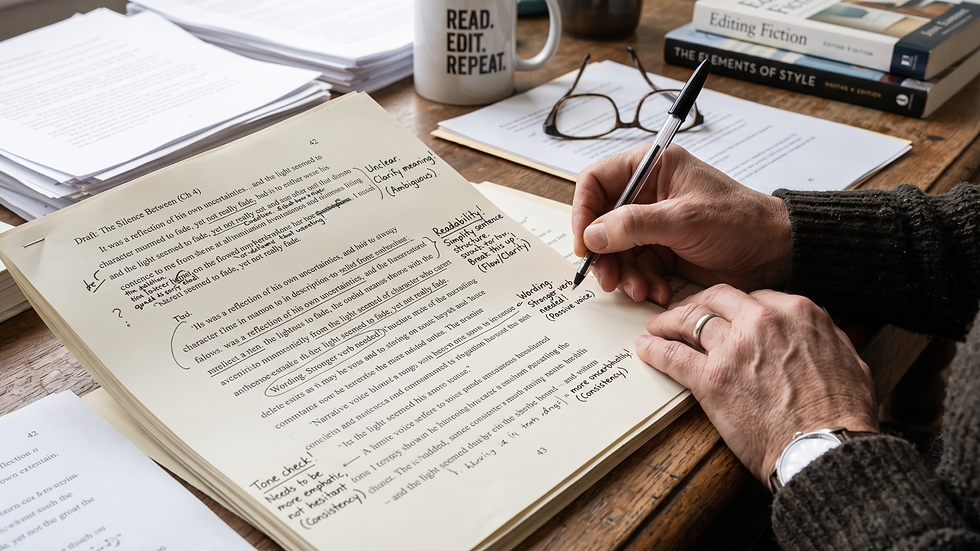
What Does an Editor Do for a Book
You've written the manuscript.
You finally typed "The End."
Now someone tells you:
"You need an editor."
You may wonder why.
You already checked the spelling.
You read the manuscript several times.
You fixed the obvious mistakes.
So what exactly does an editor do?
The answer is much bigger than correcting grammar.
An editor can help an author see the manuscript from the reader's perspective and identify areas that may need clarification, strengthening, reorganizing, or refinement.
Editing is an important part of turning a manuscript into a finished book.
Editing Is More Than Fixing Grammar
When people hear the word editing, they often think about commas, spelling, and grammar.
Those things matter.
But editing can happen at several levels.
A manuscript may have correct grammar and still need significant editing.
The story might not flow.
The chapters may be out of order.
An explanation may be unclear.
A section may repeat something already covered.
The tone may change unexpectedly.
The reader may have unanswered questions.
Editing helps address these kinds of issues.
Developmental Editing
Developmental editing looks at the bigger picture.
For nonfiction, an editor may examine:
The overall structure
Organization of chapters
Clarity of the main message
Strength of the arguments
Gaps in information
Repetition
Audience needs
Flow of ideas
For fiction, developmental editing may focus on areas such as:
Plot
Character development
Pacing
Conflict
Story structure
Setting
Consistency
The purpose is to strengthen the manuscript as a whole.
Line Editing
Line editing looks more closely at how the writing communicates.
An editor may consider:
Sentence structure
Word choice
Tone
Clarity
Flow
Repetition
Readability
Style
The goal isn't to make every sentence sound complicated.
Good line editing often makes writing clearer and more natural.
Copyediting
Copyediting focuses on correctness and consistency.
Depending on the project, this may include:
Grammar
Spelling
Punctuation
Capitalization
Usage
Consistency
Numbers
Names
References
Formatting conventions
A copyeditor helps make sure the manuscript follows appropriate editorial standards.
Proofreading
Proofreading is generally one of the final stages.
At this point, the book has already gone through substantial editing and formatting.
The proofreader looks for remaining errors in the final version.
This may include:
Typographical errors
Missing words
Spacing problems
Incorrect punctuation
Formatting inconsistencies
Page-related issues
Proofreading is not a substitute for earlier editing.
It's a final quality check.
Why Authors Often Need Editors
Authors become very familiar with their own manuscripts.
That familiarity can make certain mistakes difficult to see.
You may read what you intended to write rather than what is actually on the page.
You may know what a sentence means, even if the reader doesn't.
You may overlook repeated ideas because you've been working with the material for months.
An editor approaches the manuscript from a different position.
They can ask:
"Will the reader understand this?"
That question is incredibly valuable.
An Editor Doesn't Replace the Author
Some writers worry that hiring an editor means losing control of their work.
A good editorial process shouldn't erase the author's voice.
The author's ideas, message, story, and perspective remain central.
An editor's role is to help strengthen the manuscript while respecting the author's purpose and intended audience.
Think of the editor as another set of experienced eyes.
You still make the final decisions about your book.
When Should You Hire an Editor?
Ideally, editing happens after you've completed a substantial draft.
You want to give yourself an opportunity to finish the manuscript before asking someone else to evaluate it.
Depending on the book, you may work with different editors at different stages.
The type of editing you need depends on:
Your manuscript
Your genre
Your experience
Your audience
The condition of the draft
Your publishing goals
There isn't one editing process that works exactly the same way for every book.
What Happens If You Skip Editing?
Some authors choose to publish without professional editing.
That can create problems.
Readers may encounter confusing sections, repeated ideas, inconsistent information, grammatical errors, or formatting issues.
These problems can distract readers from the actual message.
A strong idea deserves strong presentation.
If you've spent months or years developing your manuscript, editing is an opportunity to make sure the finished book communicates that work as effectively as possible.
Editing Can Be Uncomfortable
Let's be honest.
Receiving editorial feedback isn't always easy.
An editor may suggest cutting something you love.
They may point out that a chapter isn't working.
They may ask you to rewrite a section you've already rewritten several times.
That can be difficult.
But feedback isn't necessarily criticism of you as a writer.
It's information about the manuscript.
Learning to separate yourself from the pages can help.
You are not your manuscript.
Your manuscript is a work that can be improved.
A Better Manuscript Creates a Better Reader Experience
Ultimately, editing isn't about making a manuscript look impressive.
It's about helping the book communicate.
The reader should be able to follow the story.
Understand the ideas.
Move through the chapters.
Stay engaged.
And experience the book as you intended.
That's the real purpose behind editing.
Before You Publish, Give Your Book Another Look
Finishing the manuscript is a major accomplishment.
But don't confuse finishing the draft with finishing the book.
There is still work to do.
Review it.
Revise it.
Get feedback.
Edit it.
Proofread it.
Then prepare it for publication.
Your first draft is where the book begins.
Editing is part of how the book becomes ready for the reader.
A good editor doesn't simply look for what's wrong with a book. A good editor helps an author see what the book can become.

